




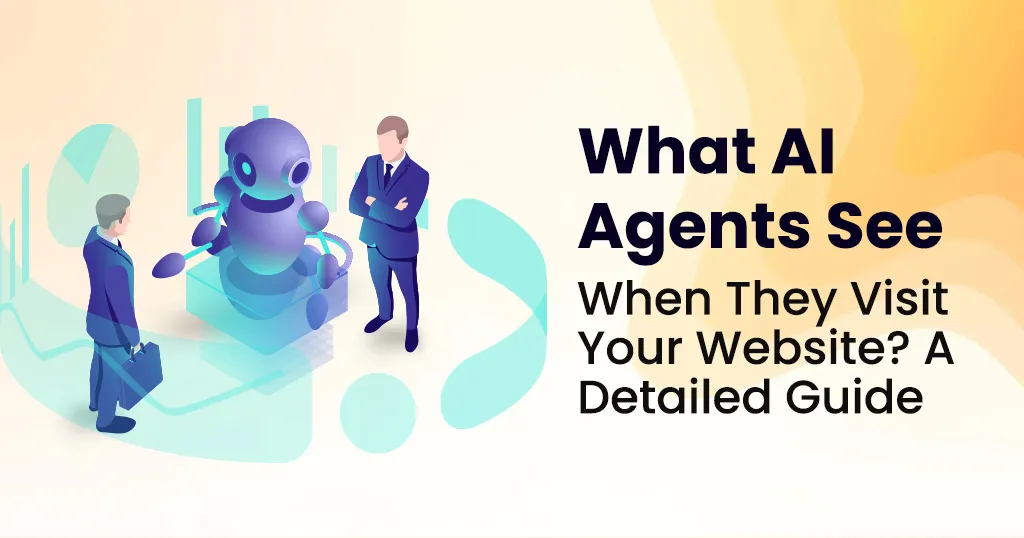
Everyone is talking about website optimization for AI agents, though most of us do not have clarity on the measures to adopt to optimize a website for AI. As of now, digital marketers have learnt that Answer Engine Optimization (AEO) is not the same as search engine optimization (SEO). Therefore, website owners should adopt some advanced measures to gain visibility through answer engines and AI snippets of search engines.
Content plays an important role here, though many experts feel that drafting content for AI engines feels similar to writing content for SEO back in 2004-05. Besides content, a website should undergo many other technical improvements to please AI bots. So, what are those improvements? The answer lies in the answer to the question: what AI agents see when they visit your website?
Let’s dive into a comprehensive guide on how website optimization works for answer engines or AI bots.
50% of Your Web Traffic Is Now from Bots
Before moving forward, let’s understand how AI engines have impacted your monthly website traffic. As per a report, more than 50% of your website traffic is now from bots. Popular AI platforms such as Google Gemini, ChatGPT, Perplexity, Claude, and more feature your website pages and blogs to drive a significant traffic share every month. Optimizing the website for these answer engines will eventually increase the traffic share from them, resulting in developing higher sales prospects.
While traffic share is increasing from AI bots, traffic from search engine rankings has dropped significantly. You must have observed that Google now features AI snippets in most search results. Since a visitor gets satisfying information on the AI snippets, they do not click on the links that are ranking, even in the top three search results of Google. If the trend continues, optimizing the website for AI becomes a necessity rather than an option.
AI Search Gap Analysis
AI search gap analysis refers to a structured process that audits why AI does not feature your website in the user queries. The AI-driven search ecosystem prefers websites with certain qualities. The AI search gap analysis will help you to understand whether your business website has those qualities or not.
Step 1: AI-Focused Query Clusters
The first step towards optimizing your website for an AI engine is identifying the AI-focused queries related to your business. Once you collect those queries, check whether they appear in your existing website content. Depending on the user’s intents, you can divide the queries into the following categories.
- Information queries (questions starting with how, what, etc.)
- Comparison queries (Comparing two or more products or services)
- Cost-based queries
- Problem-solving queries
- Query seeking top lists
So, create a list of queries according to the categories discussed above. Your website content may not be answering all of them. So, fix those gaps by adding content to appear in the results of answer engines.
Step 2: Entity Recognition Strength
If you want your website to be recognized by AI, you should prioritize entities over keywords. The second step of the AI search gap analysis is identifying entity recognition strength. Promote your brand online across different social media channels and other online platforms to draw the attention of the AI engines. The idea is to make entity signals so strong that AI can find confidence in referring your website to the queries of different individuals or users.
Step 3: Reverse Engineer Competitor Citations
An essential step of the AI search gap analysis is tracking the competitors. In the beginning, you need to check the competitors that are frequently appearing in AI answers or snippets. Once you have a list of such business rivals, you need to check or analyze the strategies that they have deployed. Following the footprints of the competitors often fetches success in answer engine optimization. SEO experts also often follow their competitors’ footprints to develop SEO strategies that fetch results.
Step 4: Audit Content Depth
A lack of content depth is probably one of the reasons why AI is not featuring your business website for users’ queries. For content depth audit, experts at a professional AEO agency would maintain the following checklist:
- Data-Rich: Is your content data-rich – featuring important statistics and studies from reputed agencies? AI bots love data, statistics, studies, surveys, etc.
- Relevance: Is your content relevant to the topic? Content that lacks relevance and coherence often fails to perform well.
- QA Types: Does your website content display a question-and-answer pattern from beginning to end? If not, it is not AI-appropriate content.
- FAQs: Having FAQs is mandatory to gain the AI engine’s attention. Typically, content should have 6-10 FAQs in the end.
Step 5: Create a Detailed Report
When you have identified the potential content gaps, it is time to create a detailed report. The report is crucial for the next step: fixing the content gaps by developing advanced strategies. Building strategies for the answer engine optimization is not as straightforward as SEO. From fixing content to improving content’s relevance and staying aligned with user intents, many essential elements need to be covered to fix or address the content gap.
Treat AI as Your Premium Visitors
Every business website drafts the content and develops navigational strategies, keeping the premium visitors in mind. Along with the premium human visitors, you should keep the AI bots in mind. The AI crawlers love the website that is information-rich. At the same time, it is crucial to improve the trust index by adding citations to the content.
Having done all these things with precision will eventually help your business website appear in the AI answers to the user queries. However, keep in mind that there is no proven strategy to appear in AI snippets. Despite covering all bases, you may not find success in this. It mainly happens when your website is relatively new or your brand is lesser-known. Building a sustainable brand value takes time and continuous effort.
Bottom Line
Hope this article has answered your doubts related to what AI agents see when they visit your website. The strategies that you deploy for the search engine crawlers may not work for the AI crawlers. However, optimizing a website for the search engines has often been noted to fetch positive impacts in AI appearance.
Additional measures are essential to feature your website content in the AI engine’s answer to user queries. The tricks discussed in this article can help your website to increase online visibility through answer engines. However, it is always good to find professional assistance in this regard. Contact Digital Mitro, a leading digital marketing agency in Kolkata, for meticulous upgrades to your business website for an enhanced online visibility through both search and AI engines.