




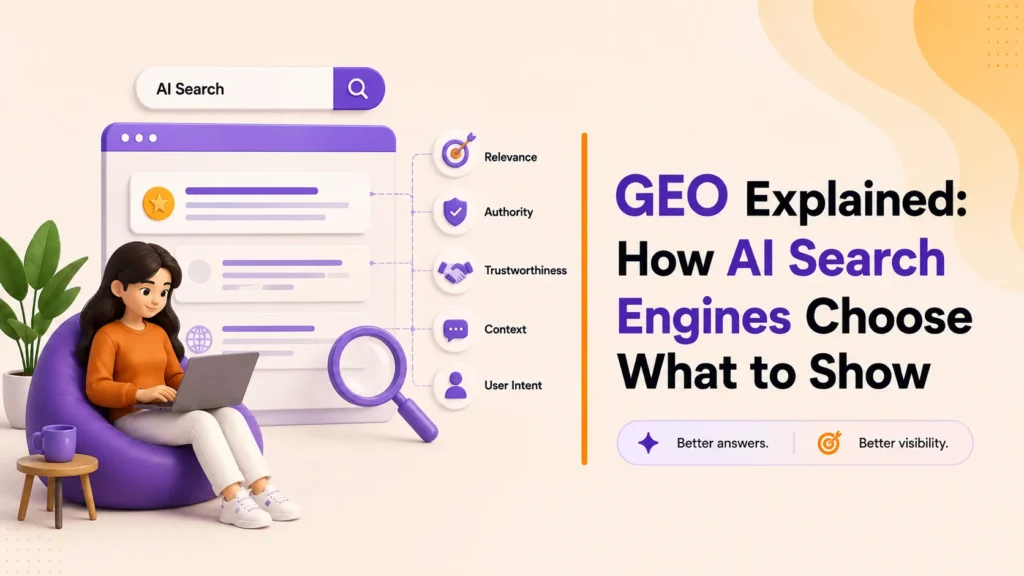
Search is changing. When people use Google, ChatGPT, Gemini, or other AI-powered search platforms, they may no longer see only a list of webpages. Instead, they can receive a direct answer generated from information gathered from multiple sources.
This creates an important question for businesses: how does an AI search engine decide what information to use? This is where Generative Engine Optimization (GEO) comes in.
GEO focuses on improving how easily your content can be discovered, understood, evaluated, and potentially referenced by AI-powered search systems. But GEO isn’t about abandoning traditional SEO — it’s about understanding how search is evolving and making your content useful in both traditional and generative search experiences.
01 What Is GEO?
Generative Engine Optimization (GEO) is the practice of optimizing content to improve its visibility in AI-generated search results and answers. Traditional SEO primarily focuses on helping webpages become discoverable and rank for relevant searches. GEO considers another question: can this content become a useful source when an AI system generates an answer?
This distinction matters because AI search can combine information from multiple sources before producing a response. Your website may therefore gain visibility through:
- Brand mentions
- Citations
- Recommendations
- Facts or statistics used in an answer
- Specific sections of your content being referenced
The goal isn’t simply to rank a page. It’s to make your information useful enough to become part of the answer.
02 How AI Search Is Different From Traditional Search
Traditional search generally works like this:
Traditional search (top) hands users a list of pages. AI-powered search (bottom) retrieves, evaluates, and synthesizes information into one answer.
With traditional search, users typically scan results and decide which webpage to visit. With AI search, the system may gather information from several sources and synthesize it into a single response. That changes the visibility question for businesses — instead of asking only “where does my website rank?” businesses also need to ask: “is my brand or information being used in AI-generated answers?”
03 How AI Search Engines Choose What to Show
There isn’t one universal process used by every AI search engine — different platforms use different technologies and systems. However, the process can be broadly understood through five stages.
The AI Understands the Query
The first step is understanding what the user actually wants. “Solar panels Illinois” is a broad search, but “how does net metering work for Illinois homeowners?” has a much clearer informational intent. Content should be built around real questions and user needs, not repeated keywords.
The System Finds Relevant Sources
Once the query is understood, the system needs information to answer it — this is where retrieval matters. If your content cannot be discovered or retrieved, it cannot contribute to an AI-generated answer. This is one reason GEO and SEO are closely connected.
The System Evaluates Information
The internet contains countless pages on the same topics, so an AI system needs to determine which information is useful. Relevance, accuracy, expertise, authority, freshness, specificity, originality, and supporting evidence can all contribute — though these aren’t a universal ranking checklist. The practical goal is credible, relevant, well-supported content.
The AI Identifies Useful Information
An AI system doesn’t necessarily need your entire article — it may find one particular section especially useful. A long article about electric vehicles may contain one especially clear explanation of charging times, which alone could answer a specific question. Clear, extractable definitions, statistics, and comparisons matter.
The AI Generates the Answer
Finally, the system generates a response using the information it has retrieved, often combining several sources rather than relying on one webpage. GEO isn’t about getting an article to “rank” — it’s about creating content that can become a useful, credible source.
AI systems often extract one useful section rather than an entire article — making clarity at the paragraph level just as important as the page overall.
04 GEO vs SEO: What’s the Difference?
SEO and GEO are closely connected, but they aren’t exactly the same:
SEO
- Focuses on organic search visibility
- Rankings are an important outcome
- Keywords and search intent matter
- Organic traffic is a key metric
- Optimizes webpages for search
GEO
- Focuses on generative search visibility
- Citations and mentions can be important outcomes
- Questions, context, and usefulness matter
- AI visibility can add new measurement opportunities
- Optimizes information for generative search experiences
GEO doesn’t mean SEO is no longer important. A strong SEO foundation can support discoverability, accessibility, site structure, and content quality — all of which remain valuable as search becomes more AI-driven. For a deeper comparison of the two approaches, see our guide on SEO vs GEO.
05 What Makes Content More GEO-Friendly?
There is no magic formula that guarantees an AI system will cite your website. Instead, focus on making your content genuinely useful.
Answer Questions Directly
Give readers a clear answer before moving into deeper explanations.
Use Clear Headings
Structure content around meaningful topics and questions rather than vague headings.
Make Information Easy to Understand
Use concise paragraphs, definitions, lists, tables, and examples where they improve clarity.
Add Original Insights
Generic content is everywhere. Original research, first-hand experience, expert opinions, and proprietary data add real value.
Support Important Claims
Where appropriate, support statistics and factual claims with credible evidence and relevant context.
Keep Content Updated
Information about technology, regulations, pricing, and industry trends can quickly become outdated. Regular updates maintain accuracy.
06 Common GEO Mistakes to Avoid
As interest in GEO grows, businesses can easily focus on the wrong things.
Treating GEO as a Replacement for SEO
GEO should build on your existing search foundation rather than replace it.
Keyword Stuffing
AI search doesn’t require unnatural repetition of keywords. Focus on answering the underlying question.
Creating Content Only for AI
Your content still needs to work for people. If humans find it confusing, AI optimization won’t fix the underlying problem.
Publishing Generic AI Content
AI can help with research, ideation, and drafting, but content should still provide expertise, originality, and real value.
Measuring Only Traffic
AI search can introduce visibility that doesn’t immediately result in a website visit. Brand mentions, citations, visibility for important queries, branded searches, and conversions may also become useful signals.
07 How Can Businesses Measure GEO Success?
GEO measurement is still developing. Traditional SEO metrics such as rankings, impressions, clicks, and organic traffic remain important, but businesses can also begin monitoring:
The goal isn’t to replace SEO reporting — it’s to understand a broader picture of search visibility.
08 Frequently Asked Questions
What does GEO stand for?
GEO stands for Generative Engine Optimization. It refers to strategies designed to improve how content is discovered, understood, and potentially referenced by AI-powered search systems.
How does GEO work?
GEO focuses on creating relevant, useful, trustworthy, and clearly structured content that AI systems can discover and use when generating answers.
How do AI search engines choose sources?
Different platforms use different processes, but they generally need to understand the query, retrieve relevant information, evaluate sources, and use selected information to generate an answer.
Is GEO replacing SEO?
No. GEO and SEO overlap in important areas. SEO fundamentals such as technical accessibility, discoverability, site structure, and quality content remain important for AI search visibility.
How can I get my website cited by AI?
There is no guaranteed method. Creating authoritative, original, accurate, well-structured content that directly answers relevant questions can improve the usefulness of your website as a potential source.
09 Final Thoughts
AI search is changing how people discover information. Instead of simply choosing a webpage from a list of results, users can increasingly receive answers synthesized from multiple sources. For businesses, that creates a new opportunity for visibility.
The answer isn’t to abandon SEO or chase AI-specific shortcuts. It’s to create content that is discoverable, trustworthy, relevant, original, and genuinely useful. SEO provides an important foundation. GEO adds another layer by considering how that information can be surfaced and used within AI-powered search experiences.
The future of search visibility isn’t just about being found. It’s about becoming a source worth using.
Want Your Content to Show Up in AI Answers?
Digital Mitro helps businesses in Kolkata and beyond build content that works across traditional SEO, AEO, and GEO — discoverable, credible, and built to be cited.
Talk to Our SEO Experts